Google Analytics is a powerful tool that tracks and analyzes website traffic for informed marketing decisions.
Service URL: policies.google.com (opens in a new window)
_gac_
Contains information related to marketing campaigns of the user. These are shared with Google AdWords / Google Ads when the Google Ads and Google Analytics accounts are linked together.
90 days
__utma
ID used to identify users and sessions
2 years after last activity
__utmt
Used to monitor number of Google Analytics server requests
10 minutes
__utmb
Used to distinguish new sessions and visits. This cookie is set when the GA.js javascript library is loaded and there is no existing __utmb cookie. The cookie is updated every time data is sent to the Google Analytics server.
30 minutes after last activity
__utmc
Used only with old Urchin versions of Google Analytics and not with GA.js. Was used to distinguish between new sessions and visits at the end of a session.
End of session (browser)
__utmz
Contains information about the traffic source or campaign that directed user to the website. The cookie is set when the GA.js javascript is loaded and updated when data is sent to the Google Anaytics server
6 months after last activity
__utmv
Contains custom information set by the web developer via the _setCustomVar method in Google Analytics. This cookie is updated every time new data is sent to the Google Analytics server.
2 years after last activity
__utmx
Used to determine whether a user is included in an A / B or Multivariate test.
18 months
_ga
ID used to identify users
2 years
_gali
Used by Google Analytics to determine which links on a page are being clicked
30 seconds
_ga_
ID used to identify users
2 years
_gid
ID used to identify users for 24 hours after last activity
24 hours
_gat
Used to monitor number of Google Analytics server requests when using Google Tag Manager
1 minute
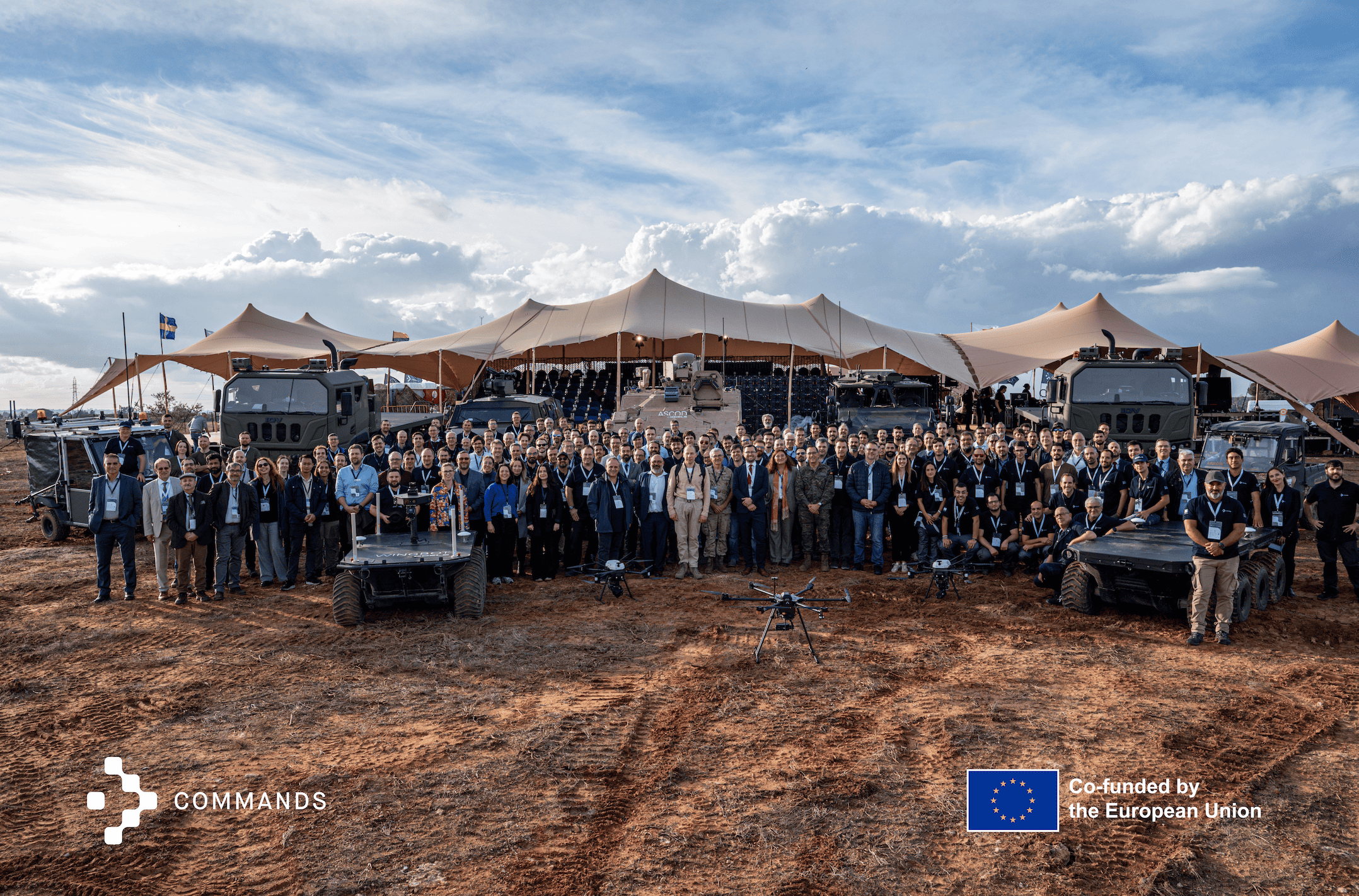
A few months ago, the COMMANDS project reached its conclusion following a successful final demonstration in Seville, showcasing the innovative capabilities developed under this European Defence Fund initiative.
During the event hosted by GDELS Santa Bárbara Sistemas, COMMANDS demonstrated several key operational capabilities:
An intelligent, protected last kilometre re-supply convoy:
A realistic military scenario showcasing the convoy using a combination of armoured and unarmoured vehicles, highlighting their real-time Command and Control (C2) and rapid C4I responses to simulated threats like ambushes, IEDs, and electronic warfare.
Manned-Unmanned teaming and hybrid swarming:
Coordinated operations between manned and unmanned ground vehicles (UGVs) in an agile, hybrid swarming context, which includes UGVs, UAVs, and manned platforms. Throughout this COMMANDS demonstrated autonomous navigation, formation changes, and obstacle avoidance.
Advanced C4I, ISR, and interoperability:
The demonstration of UAVs providing ISR support showcased NATO’s interoperability of tactical information and compatibility with EU defence systems. Through integrated C4I systems for situational awareness and decision-making, which include the use of an Intelligent Digital Assistant (IDA) and AI-driven mission planning/rerouting.
Congratulations to all partners for their collaboration and dedication throughout the project, and to the European Commission and the six supporting EU Ministries of Defence for their continued support. Sener Aerospace & Defence, Vetronics Research Centre, BPTI, Clavister, Eight Bells Ltd, GDELS Santa Bárbara Sistemas, IKNOWHOW SA, Indra Group, Instituto Nacional de Técnica Aeroespacial «Esteban Terradas», INTRACOM DEFENSE, Iveco Defence, Leonardo, War and Peace Centre – Link Campus University, LNE, MASA Group, Politecnico di Milano, SCERTAS GmbH, SignalGeneriX Ltd, SKYLD SECURITY AND DEFENCE LTD, Military University of Technology.
While the COMMANDS project has now reached its conclusion, the work to advance these technologies and capabilities continues.
For more information about the project, please contact: contact@edfcommands.eu